

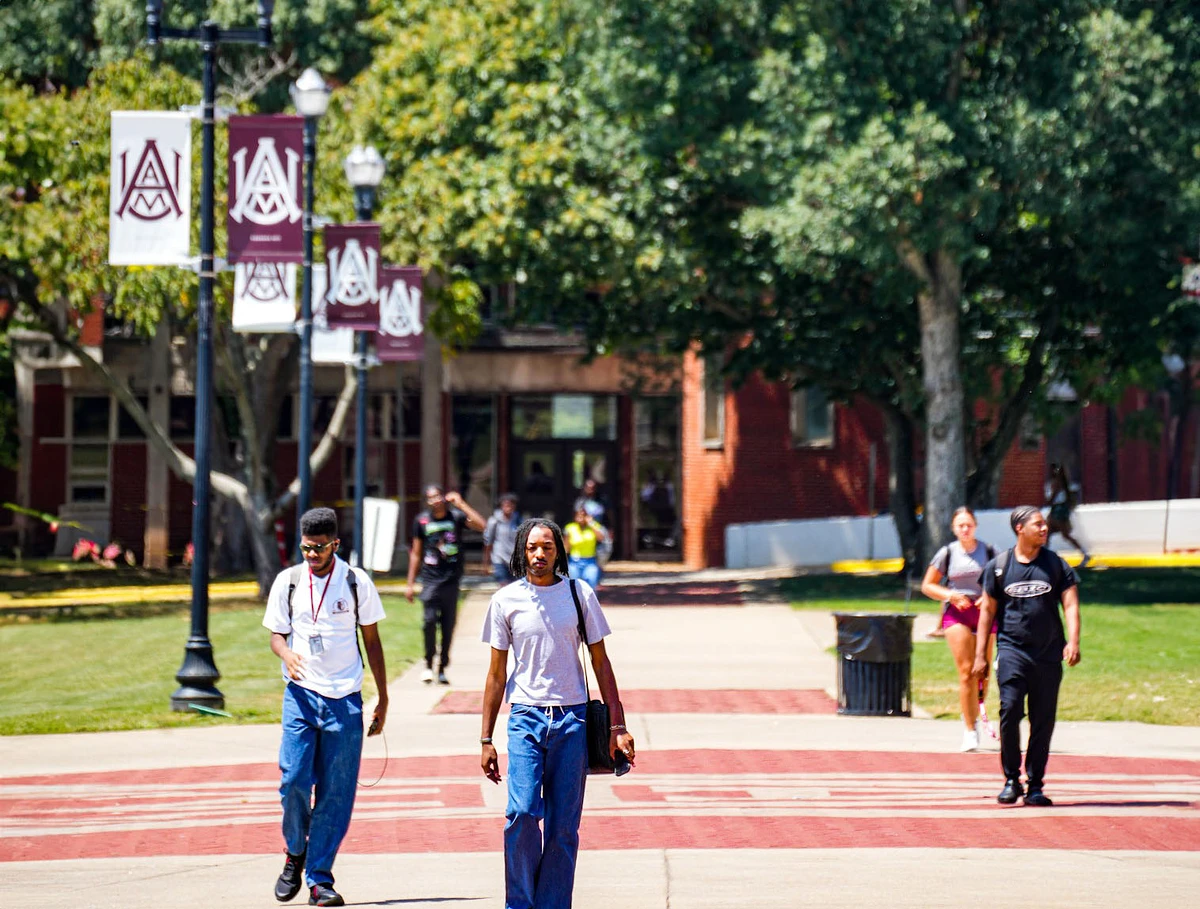
Alabama A&M’s Class of 2030 adds to a larger enrollment story unfolding across historically Black colleges and universities as several institutions report large incoming classes, record enrollment and strong student demand.
HUNTSVILLE, Ala. — HBCU enrollment growth is continuing across several of the nation’s historically Black colleges and universities, with Alabama A&M University welcoming about 2,200 first-time freshmen for fall 2026.
Alabama A&M’s incoming Class of 2030 joins large recent classes at North Carolina A&T State University, Morgan State University and Howard University, while Florida A&M University has reported tens of thousands of first-year applications.
Together, the numbers offer a snapshot of strong student demand at several HBCUs and raise a larger question about what continued enrollment growth means for the institutions serving those students.
Alabama A&M Welcomes 2,200 Freshmen for Fall 2026
Alabama A&M officially welcomed its Class of 2030 during the university’s annual Freshman Torch Lighting Ceremony on Saturday.
University President Daniel K. Wims announced a preliminary registration of 2,200 first-time freshmen for fall 2026.
The incoming class represents 37 states and eight countries, according to the university. Women make up 59% of the class, while men account for 41%. Students enter Alabama A&M with an average high school GPA of 3.25 and an average ACT score above 18.
“This exceptional class represents the rich diversity and far-reaching spirit of the University,” Wims said during the ceremony.
The size of Alabama A&M’s incoming class is significant, but the university is not alone. Several HBCUs have reported large incoming classes or substantial enrollment growth in recent years.
North Carolina A&T Enrollment Tops 15,000 Students
North Carolina A&T State University reached a historic enrollment milestone in fall 2025.
The university enrolled 3,021 first-year students as its overall enrollment climbed to a record 15,275 students.
That made North Carolina A&T the first HBCU to surpass 15,000 students.
The 2025 entering class represented an increase of about 10% from the previous year, according to the university. Students came from 36 states and Washington, D.C., and entered with an average high school GPA of 3.7.
North Carolina A&T’s total enrollment increased 6.7% from 14,311 students in fall 2024.
The growth reinforced the university’s position as the nation’s largest HBCU and provided another indication of the demand for an HBCU education.
Morgan State Enrollment Reaches Another Record
Morgan State University has experienced a significant enrollment surge of its own.
The Baltimore university enrolled a record 11,559 students for the 2025-26 academic year, marking its fifth consecutive year of record enrollment.
Morgan reported 2,325 full-time, first-time freshmen in fall 2025, according to university enrollment data.
The longer-term growth is particularly notable.
In fall 2020, Morgan enrolled 1,202 full-time, first-time freshmen. By fall 2025, that number had increased to 2,325, an increase of more than 90% in five years.
Overall enrollment increased from 7,634 students in 2020 to 11,559 in 2025.
Howard University Draws Record Student Interest
Howard University has also experienced strong demand from prospective students.
The Washington university received 36,393 applications for fall 2024, which the university described as a record.
Approximately 2,796 new students enrolled that fall, according to Howard. The incoming class was 23% larger than the previous year’s class.
The university also reported that its fall 2024 application total represented a 79% increase from fall 2022.
The numbers demonstrate another side of the HBCU enrollment story: Demand at some institutions extends well beyond the number of students who ultimately enroll.
FAMU Receives More Than 22,000 Applications
Florida A&M University has also attracted substantial interest from prospective students.
According to the university’s 2024-25 Common Data Set, FAMU received 22,756 first-time, first-year applications for fall 2024.
The Tallahassee, Florida, university admitted 4,678 of those applicants, with 1,429 enrolling.
While FAMU’s incoming class was smaller than some of the other institutions examined, its application volume provides another measure of demand for admission to an HBCU.
What HBCU Enrollment Growth Means for Black Colleges
Comparing freshman enrollment across HBCUs is not exact.
Universities use different terms and definitions when reporting incoming students. Some report first-time freshmen, while others report first-year students or total new students. The latest available figures also represent different academic years.
Recent figures reported by the universities include:
- North Carolina A&T: 3,021 entering first-year students, fall 2025
- Howard University: approximately 2,796 new students, fall 2024
- Morgan State University: 2,325 full-time, first-time freshmen, fall 2025
- Alabama A&M University: preliminary registration of 2,200 first-time freshmen, fall 2026
- Florida A&M University: 1,429 first-time, first-year students enrolled, fall 2024
The figures should not be considered a ranking of the largest HBCU freshman classes because reporting methods and years differ.
They do, however, offer a look at the scale of enrollment and admissions activity at several of the nation’s HBCUs.
And growth brings opportunity as well as challenges.
Larger student populations can increase demand for campus housing, classroom space, faculty, financial aid, technology and student services. Institutions experiencing sustained enrollment growth must also focus on retaining students and providing the resources needed to help them graduate.
The growth comes as HBCUs are expanding their work in research, technology, artificial intelligence, health care, engineering, entrepreneurship and workforce development.
North Carolina Central University, for example, recently opened a building dedicated to its Institute for Artificial Intelligence and Emerging Research, another example of HBCUs investing in areas expected to shape the future workforce.
Enrollment, therefore, is only one part of the story. The larger question is how HBCUs will use increased student demand to expand their academic reach, strengthen their institutions and prepare the next generation of graduates.
A New Class Begins at Alabama A&M
At Alabama A&M, the larger HBCU enrollment story became personal Saturday as thousands of new Bulldogs gathered to begin their college experience.
During the Freshman Torch Lighting Ceremony, Alabama A&M alumnus Craig Mitchell challenged students to approach their years on The Hill with purpose.
“It’s going to take instinct, pressure, and purpose,” Mitchell told students. “That’s what it takes to climb the hill.”
The ceremony symbolically passed the torch to the Class of 2030, marking the beginning of its journey at Alabama A&M.
For the approximately 2,200 first-time freshmen entering the university this fall, that journey is just beginning.
Their arrival also adds another data point to a larger story developing across higher education: Thousands of students are choosing HBCUs, while thousands more are competing for the opportunity to attend them.
For historically Black colleges and universities, the next chapter will be about more than how many students arrive.
It will be about what happens after they get there.
HBCU Times reviewed enrollment and admissions information published by Alabama A&M University, North Carolina A&T State University, Morgan State University, Howard University and Florida A&M University. Enrollment categories and reporting periods vary by institution, and the figures should not be interpreted as a formal ranking of HBCU freshman class sizes.

[…] investment also comes as HBCUs continue to experience increased enrollment, student demand and institutional growth, creating new conversations around the resources and technology needed to support expanding student […]