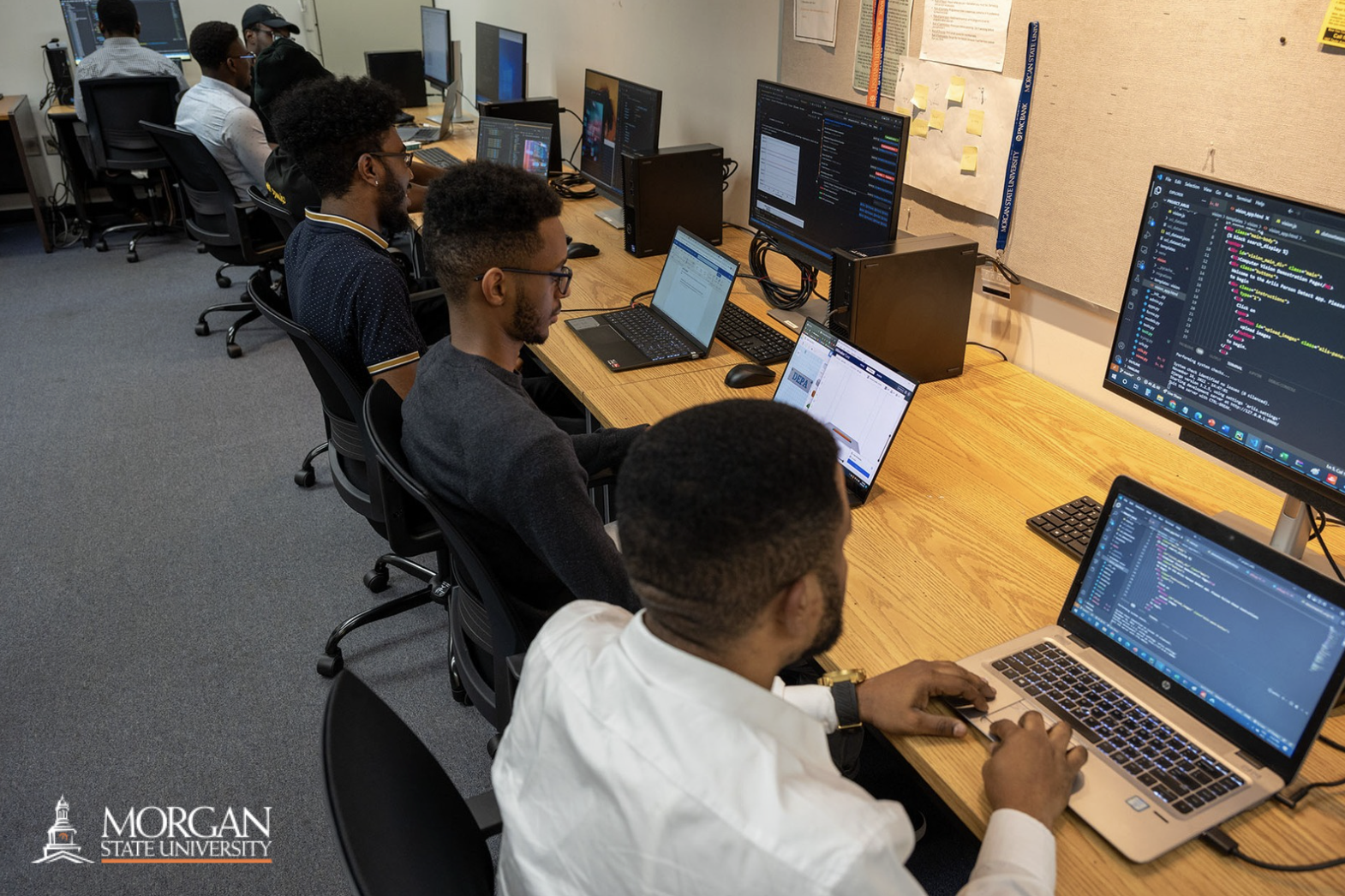
Morgan State University is building more than an AI-powered campus. Its new collaboration with Google Public Sector could offer a glimpse into how HBCUs can approach research, workforce development and institutional leadership in the artificial intelligence era.
BALTIMORE – Morgan State AI is taking center stage as the university expands its artificial intelligence strategy through a new collaboration with Google Public Sector, a move that could carry significance far beyond its Baltimore campus.
The university announced Sept. 10 a new collaboration with Google Public Sector aimed at developing what it describes as a next-generation, AI-driven research campus. Through Google Public Sector’s Program for Accelerated Research, Morgan will gain access to high-performance GPU computing resources that can support advanced work in artificial intelligence, cybersecurity, climate science, health sciences and other fields.
But for the HBCU community, the larger story may not simply be that Google is coming to Morgan State.
It is that Morgan is positioning itself to help shape what an AI-powered HBCU can become.
The new computing capacity is expected to expand research opportunities for faculty and students while supporting Morgan’s continued pursuit of Carnegie R1 research status. The university also plans to establish a Google-focused Center of Excellence centered on cloud computing, AI adoption, workforce development and technical training.
Students are expected to gain exposure to professional credentials and career pathways through Google’s training ecosystem, while researchers gain access to computing technology capable of supporting increasingly complex projects.
Building an AI Ecosystem at Morgan State
Morgan, however, is not beginning its AI journey with this announcement.
Earlier this year, the university introduced the first version of Obsidian, a homegrown artificial intelligence platform created to support Morgan’s growing AI ecosystem. University officials have emphasized institutional governance, security and accountability as part of the platform’s development.
That distinction matters.
As colleges across the country determine how AI should be used in classrooms, research and campus operations, Morgan is asking a larger question: How can universities participate in AI innovation while maintaining greater control over their data, systems and institutional priorities?
Morgan also announced this month that its athletics program received a $100,000 NCAA grant to develop an AI-enhanced academic support initiative for student-athletes. The technology is expected to help connect students with information involving advising, eligibility, wellness and other resources.
Taken together, the developments suggest a strategy that stretches beyond providing students access to the latest AI tools.
The Morgan State AI strategy is increasingly focused on building an ecosystem around those tools, research opportunities and institutional priorities.
That approach could also help broaden access to high-level research opportunities for students who have historically been underrepresented in technology and artificial intelligence fields.
What Morgan State AI Could Mean for Other HBCUs
For HBCUs, that creates an important conversation.
Not every institution has Morgan State’s research capacity or resources, and replicating its model exactly may not be realistic for every campus. But the larger strategy could still provide a blueprint.
A smaller HBCU might prioritize faculty AI training. Another might focus on cybersecurity, workforce credentials or partnerships that provide students access to advanced computing resources. Others could incorporate AI into agriculture, journalism, business, health care or teacher preparation.
The model does not necessarily have to look the same.
The investment also comes as HBCUs continue to experience increased enrollment, student demand and institutional growth, creating new conversations around the resources and technology needed to support expanding student populations. HBCU Times recently reported that Morgan State reached a record enrollment of 11,559 students for the 2025-26 academic year, its fifth consecutive year of record enrollment.
The larger objective is ensuring HBCUs are not left on the sidelines as artificial intelligence reshapes education and the workforce.
For generations, HBCUs have prepared talent for industries that have not always invested proportionately in the institutions producing that talent. AI presents another pivotal moment.
The opportunity is no longer simply to teach students how to use artificial intelligence.
HBCUs also have an opportunity to research it, govern it, build with it and influence how it is used.
The Morgan State AI strategy offers one example of what that future could look like for HBCUs navigating this rapidly changing landscape.
And if the model succeeds, its impact may extend well beyond Baltimore.